Agenda
Chapter 1

Agenda
Chapter 1

Venture Clienting has its own methodology, its own terminology, and its own set of operational principles derived from hundreds of programs run across dozens of industries.
This cluster covers the foundations: what practitioners have learned about what works, how programs are benchmarked, and how industry and company context shapes the questions you’ll face.
Strategic context for your Venture Clienting program: industry adoption patterns, company size considerations, and the essential vocabulary of the field. Venture Clienting has its own methodology, its own terminology, and its own set of operational principles derived from hundreds of programs run across dozens of industries. This cluster covers the foundations: what practitioners have learned about what works, how programs are benchmarked, and how industry and company context shapes the questions you’ll face.
Five operational principles that separate programs that deliver from those that stall. Start smart not big. Make IT your partner from day one. Build trust before you scale. Always start with a problem. Create buzz, then qualify like a professional. Each rule is grounded in patterns from successful and unsuccessful programs.
GlassDollar’s research across corporate programs identifies three maturity levels —Starter, Growing, and Pro— each with distinct PoC volumes, budget ranges, team sizes, and process requirements. Understanding which level your program is at is more actionable than any abstract innovation maturity framework.
Venture Clienting adoption and impact vary significantly across sectors and company sizes. Understanding where your industry sits, and knowing the shared language of the field, shapes program design and realistic expectations. This page covers both: the industry and company size benchmarks that determine your starting position, and the eight essential terms that appear throughout VCL work.
The market-level case
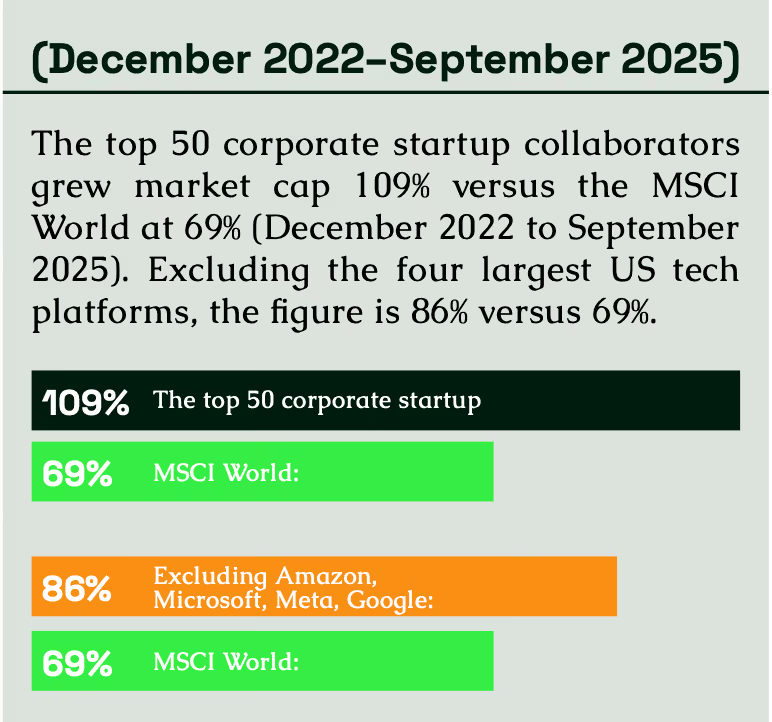
The top 50 corporate startup collaborators grew market capitalization by 109% between December 2022 and September 2025, compared to 69% for the MSCI World index. This 40-percentage-point gap holds even when the largest tech platforms are excluded: removing Amazon, Microsoft, Meta, and Google reduces the figure to 86%, still 17 points above the benchmark.
Geographic distribution
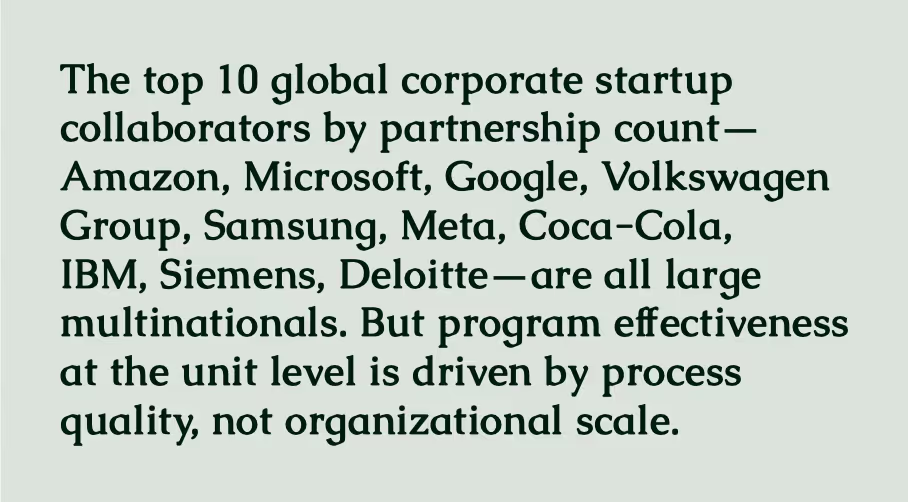
The top 50 global collaborators are concentrated in North America (56%) and Europe (38%), with Asia at 6%. The United States leads with 27 companies, followed by Germany with 10, a disproportionate representation for its economy size. Germany’s position reflects concentrated adoption of Venture Clienting as formal methodology by large German industrial and automotive companies. Many of the most mature VCU programs globally are operated by German corporates.
Leading sectors
Technology, Media and Telecommunications is the most advanced globally, with the highest partnership volumes and longest track records. Automotive and Transport (led by Volkswagen Group’s 2,420 partnerships) demonstrates that non-tech incumbents can build serious startup collaboration capability. Manufacturing and Industrial shows clear business cases:automation, predictive maintenance, energy efficiency, and supply chain optimization map naturally to startup solutions with well-defined ROI. Travel and Hospitality, and Real Estate and Construction round out the leading tier.
On-par sectors
Financial Services, Energy and Utilities, and Retail and Consumer Goods have active programs but uneven adoption. Financial Services requires more developed IT and legal frameworks than manufacturing due to regulatory constraints around data and third-party risk.
Lagging sectors
Healthcare and Pharmaceuticals is the most significant underperformer relative to its scale and stated innovation priorities. Regulatory complexity, data privacy requirements, and procurement processes calibrated to pharmaceutical supply chains create structural barriers. For practitioners in Healthcare and Pharma, the structural barriers are real but create correspondingly large first-mover advantages.
Company size and organizational complexity
Venture Clienting works for any organization with operational problems worth solving. The relevant variable is less absolute company size than organizational complexity: the presence of a procurement function, an IT function with security review process, and multiple business units with distinct problem sets.
For larger organizations (€500M+ revenue), the main advantage is structural: problems worth solving are numerous and clearly owned, budget can be found within discretionary innovation spend, and implementation impact scales with revenue base. A 15% error rate reduction across a €5B revenue company produces materially different ROI than the same improvement at €100M revenue.
The main challenge at large scale is internal complexity. A VCU in a large matrix organization needs more deliberate stakeholder management, more developed procurement and IT frameworks, and more careful first-PoC selection than an equivalent program in a mid-sized organization.
For mid-sized companies (€100M to €500M), the program design question is whether business case for a dedicated VCU team is strong, typically three or more PoCs per year. Below that volume, a hybrid model where one person owns Venture Clienting alongside other innovation work often makes more sense than a standalone function.
What sector and size context changes
If you are in a Leading sector, set your internal bar for startup sourcing quality and PoC execution against what the best programs in your sector are achieving, not against a global average that includes programs in lagging sectors.
If you are in a Lagging sector, expect a longer runway to your first high-quality PoC and plan for more upfront investment in enabling functions (IT, legal, procurement, regulatory)than a comparably sized manufacturing program would require. The barrier to entry is higher, but so is the competitive advantage available to programs that clear it.
What sector context does not change is the fundamental logic: a structured, problem-led,fast-turnaround approach produces better outcomes than ad hoc engagement, regardless of industry.
Most Venture Clienting programs fail because of execution errors that are entirely predictable and that experienced practitioners have learned to avoid.
The five rules below are distilled from recurring patterns in how successful VCUs operate and how struggling ones lose momentum.
The instinct to launch comprehensively, full team, broad mandate, ambitious PoC targets, reliably predicts program struggles. The strongest programs today started with a single motivated person, modest budget, and one well-chosen first PoC.
Starting smart means three things:
First, do your first PoCs with people already on your side. Your earliest partners should be business unit leads who have expressed genuine interest. Credibility with allies compounds. Energy spent persuading skeptics in year one rarely pays off in time.
Second, pick easy wins for your first round. A technically ambitious first PoC with complex integration and an inexperienced startup is unnecessary risk. The objective of the first PoC is to demonstrate that the model works inside your organization, not to tackle the biggest problem. An easy win that moves to implementation does more for your program’s trajectory than a bold bet that stalls.
Third, choose your strategic partners (e.g. procurement, IT, legal, works council) before you start. Getting a named contact in each function before your first PoC contract hits their desk is not bureaucratic overhead. It is the difference between a four-week and a four-month process.
In every program that struggles with execution speed, IT is cited as a blocker. In every program running at startup speed, IT is a partner. The difference is almost always when and how the VCU engaged IT, not IT’s inherent willingness.
Standard IT security reviews are calibrated for permanent, deeply integrated enterprise software. They ask questions about long-term certifications and deep data access that don’t apply to a four-week PoC running in a sandboxed environment with five users.Applying the full enterprise vendor checklist to a limited PoC is IT applying the only framework they have unless you give them another one.
Involve IT from the first conversation about your VCU, not when a startup is waiting for access.Ask IT one specific question early: “What would a startup need to demonstrate to participate in a limited PoC with restricted access?” Write down the answer. That answer becomes your security checklist for sourcing—you filter for it before engaging startups, so IT never receives an application from a startup that cannot meet the minimum bar.
A single named IT liaison who understands what Venture Clienting asks of their function is worth more than any amount of escalation or pressure.
Budget is not the constraint that limits most programs. Credibility is. A program that has run three successful PoCs and produced one implementation has an easier conversation with leadership about resources than any program that spent its first year building infrastructure.
The sequence matters. Run three working PoCs before asking for meaningful scaling resources.Three ones that delivered measurable results and produced visible outcomes business units would describe as valuable. That track record is the asset you leverage in every subsequent conversation with leadership about budget,IT about streamlined processes, procurement about simplified contracting.
Building trust also means reliably translating between two organizational cultures that do not share a frame of reference. Startups operate on weeks-long decision cycles. Corporate processes are designed around months-long ones. Neither is wrong, both are optimized for different environments. The VCU absorbs enough friction that neither side experiences the other as frustrating. When you do this well,startups tell other startups your organization is worth partnering with. That reputation compounds.
Resist pressure to scale prematurely. A lean program that produces consistent results earns its next phase. A program that builds for scale before proving the model spends its credibility asking for resources before demonstrating returns.

A PoC without a defined business problem is not a Venture Clienting project, it is an innovation exercise with no anchor. The two produce fundamentally different outcomes.
An innovation exercise ends with an evaluation of whether the technology is interesting. A properly grounded PoC ends with a binary decision: does this solution solve the problem we defined, and is the business case strong enough to implement? The second question drives implementation rates, creates internal advocates, and generates the ROI data that justifies program investment.
No PoC brief should be written until a specific operational problem has been clearly defined by a named business unit owner. Not a problem category but a specific, measurable challenge with a clear owner, defined context, and rough hypothesis about success.
This principle also applies to startup sourcing. A VCU that identifies an impressive startup and then looks for a problem will almost always struggle to find an engaged business unit willing to run the PoC. The sourcing sequence should be: problem first, solution space second, specific startup third.
Before beginning any PoC process, you should be able to complete this sentence:
“We are testing this startup’s solution because [specific business unit] has a problem with [specific operational challenge] that currently costs[quantifiable impact], and success would mean[specific measurable outcome].”
The fifth rule applies once your program has delivered its first three successful PoCs. At that point, you have the credibility to go wide, to actively tell the organization about Venture Clienting, invite problem leads, and build the pipeline that will carry you into the Grow phase.
Going wide before you have success stories is premature. Stakeholders who haven’t seen evidence the model works will be politely non committal. After three working PoCs, the same effort produces a different result because you are not selling a concept—you are sharing evidence.
But creating buzz without rigorous qualification is also a trap. A high-visibility program that runs weak PoCs destroys credibility faster than a low-profile program that runs no PoCs. Once leads start flowing, the quality filter becomes your most important operational tool.
Four qualification questions to apply to every inbound problem lead:
1. Is there a real, clearly defined need?
Curiosity is not a problem. You need a specific operational challenge with measurable impact.
2. Is the need urgent enough to prioritize?
A problem on the backlog for three years without urgency produces a disengaged PoC partner. Look for problems where the business unit is actively feeling the pain.
3. Does the lead have decision-making authority?
The person bringing the problem needs to be able to commit to running the PoC or have direct access to that person. Middle managers without authority produce delays at every stage.
4. Is there budget or budget access?
Not necessarily a formal allocation, but a realistic path to covering the PoC cost. A problem without a budget owner is a problem without a PoC.
Leads that pass all four filters are PoC candidates. Leads that fail one or more are prospects worth keeping warm, but not ones to commit resources to until the gap closes.
Not every Venture Clienting Unit operates at the same stage of development. Treating them as if they do is a common benchmarking mistake. A unit running its first three PoCs operates fundamentally differently from one managing twenty-plus concurrent proofs of concept.
GlassDollar’s research across corporate programs identifies three distinct maturity levels—Starter, Growing, and Pro—each with characteristic PoC volumes, budgets, team sizes,and process requirements. Understanding which level your program is at, and what the next level requires, is more actionable than any abstract innovation maturity framework.
A Starter VCU is proving the model. The team is small, typically one to three people, often working on Venture Clienting alongside other responsibilities. PoC volume is low: fewer than five per year. The budget sits below €150k annually. Reporting on program impact is informal.
This is not a failure state. It is the correct starting configuration for most organizations. The Starter level is where Venture Clienting earns its internal license to operate by demonstrating the model works.
- PoC volume: fewer than 5 per year
- Annual program budget: under €150k
- Team size: 1 to 3 people
- Average cost per PoC: approximately €100k (all-in)
- Expected program impact at full Starter capacity: approximately €2-3M from 3 PoCs at a 50% implementation rate
The single most important output of the Starter level is a success story: one PoC that moved to implementation and produced measurable business outcome. That story is the ticket to the next level.
Everything else is secondary. Process sphistication and comprehensive reporting matter in Phase 2, not Phase 1. A Starter unit that spends its first year building infrastructure rather than running PoCs will have excellent frameworks and no credibility.
The three foundational relationships to establish are with procurement, IT, and legal. Not deep relationships, just enough that each function has seen one PoC contract, understands what you are doing, and has a named contact who can process future requests.

A Starter unit is ready to move to Growing when it has completed three to five PoCs, at least one of which is moving toward implementation; when procurement, IT, and legal have each processed at least one engagement; and when there is a documented return story that can be presented to leadership.
The Growing level begins when the model has been proven and the challenge shifts from demonstration to repeatability. PoC volume increases to 6-14 per year. The budget typically ranges from €150k to €1M annually. The team expands to 2-8 dedicated staff. Reporting becomes more structured with defined KPIs and regular stakeholder updates.
The informal processes that worked at Starter level begin to break down at this volume. The Growing level is where systematization becomes necessary rather than optional.
- PoC volume: 6 to 14 per year
- Annual program budget: €150k to €1M
- Team size: 2 to 8 people
- Average cost per PoC: approximately €90k
- Expected program impact at full Growing capacity: approximately €7.5M from 10 PoCs at a 50% implementation rate
Three capabilities define success at Growing level:
Sourcing quality
At Starter volume, warm introductions can surface adequate PoC candidates. At Growing volume this breaks down. A structured sourcing process, consistent brief methodology, qualified lead intake, formal startup evaluation criteria, is required to maintain quality as volume increases.
Internal stakeholder depth
Ally relationships need to develop into champion relationships. An ally processes PoC contracts when asked. A champion actively promotes Venture Clienting to colleagues and brings unsolicited problem leads. The difference in program pipeline quality is substantial.
Portfolio management
Running ten concurrent PoCs requires coordination that running three does not. A shared project management system,regular portfolio review cadence, and a clear owner for each PoC are operational requirements at this scale, not bureaucratic overhead.

A Growing unit operates effectively when it completes ten or more PoCs in the year, maintains a PoC-to-implementation rate above 40%, has active champions in at least three business units bringing unsolicited leads, and delivers regular impact reporting to leadership tied to business outcomes.
A Pro VCU is a mature institutional capability. PoC volume exceeds fifteen per year, many run twenty to thirty or more. The annual budget exceeds €1M. The team is staffed as a professional function with specialized roles. Reporting is systematic and connects directly to strategic business goals.
The defining characteristic is institutional independence: the program no longer depends on the personal network of its founder. Startup pipelines are managed through professional sourcing infrastructure. Internal engagement is driven by a repeatable business development model.
- PoC volume: more than 15 per year (many programs run 20-30+)
- Annual program budget: above €1M
- Team size: 3 to 20+ people
- Average cost per PoC: approximately €75k
- Expected program impact at full Pro capacity: €30M or more from 30+ PoCs annually
The strategic priority at the Pro level is organizational integration: formal SLA with procurement, IT, and legal (not informal goodwill, but documented turnaround commitments and agreed contract templates). This also means an annual impact report that connects program outcomes to the company’s strategic priorities.
Pro-level units that don’t complete this integration remain operationally effective but strategically vulnerable. Without structural embedding, the program’s budget and mandate remain subject to the advocacy of whoever is currently sponsoring it.
A Pro unit operating at full effectiveness runs twenty or more PoCs annually with consistent pipeline throughput, maintains an implementation rate at or above 50%, has formal integration agreements with core enabling functions, produces an annual impact report that leadership presents externally,and generates new problem leads without active internal solicitation.
There is no fixed timeline for progression. The signal is operational: when the current level’s processes are consistently delivering results and the constraint is capacity rather than capability, the program is ready for the next level.
The most common mistake is moving too early. Units that try to operate at Pro level in year one build infrastructure that has nothing to run through it. The lean discipline of the Starter level is not a weakness to overcome quickly. It is the correct configuration for the work at hand.The tools picture also evolves across levels. Starter units typically manage work in spreadsheets or lightweight tools. Growing units add startup intelligence platforms and structured pipeline management. Pro units often use dedicated Venture Clienting software with integrated sourcing, evaluation, and impact tracking.
The tool upgrade is a consequence of maturity.
